- BeyondTheCart
- Posts
- $41K from one AI tweak (Shopify)
$41K from one AI tweak (Shopify)
Sorry, I’m two days late this week. Board meeting and some big 2026 decisions for our e-commerce business kept me busy. Anyway, here’s this week’s AI for eCommerce newsletter: Shopify merchants can now sell directly inside ChatGPT, no website visit required. One store's conversational AI scaled from $6K to $41K monthly in upsells. And 91% of banks just abandoned voice verification after fraud losses hit $410M. Conversational commerce became infrastructure this month.

Nicholas Hoddevik
October 24, 2025

🚨 The Big Signal
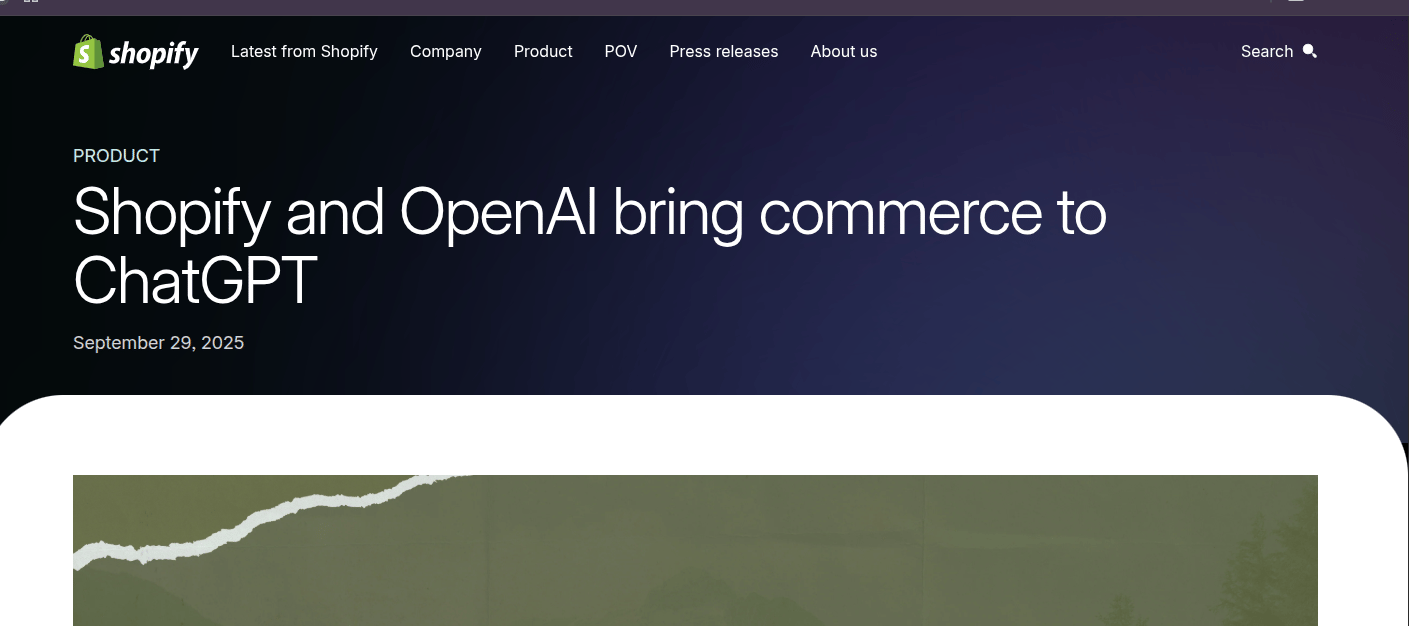
While you were buried in Q4 prep, Shopify merchants gained the ability to sell directly inside ChatGPT—no website visit, no checkout redirect, just conversation-to-purchase in three taps. OpenAI's Instant Checkout launched October 1st with Etsy sellers and is rolling out to 1M+ Shopify stores (including Glossier, SKIMS, Spanx) this quarter.
Here's what changed: ChatGPT became a sales channel. When someone asks "best running shoes under $100," they now see organic product results with a "Buy" button. One tap confirms shipping and payment—purchase complete. Merchants remain merchant of record, handle fulfillment, keep customer relationships. ChatGPT just became the world's biggest AI shopping concierge serving 100M+ weekly users.
The technical backbone: Agentic Commerce Protocol (co-developed with Stripe), now open-sourced so any platform can build in. Product discovery is organic—no ad spend influences ranking—making this either your biggest new customer acquisition channel or the place your competitors find your customers first.
Shopify's VP of Product was blunt: "Shopping is changing fast. People are discovering products in AI conversations, not just through search or ads." Translation: the era of "optimize your Google Shopping feed" is morphing into "optimize for how AI agents think about your products."
Your move: If you're on Shopify with Stripe, the integration is literally one toggle in admin settings. U.S.-only for now, global rollout Q1 2026. Even if you don't activate, understand this—conversational commerce just became the default, not the future.
Source
🛠 Tool Worth Testing: Nosto's Huginn AI Agent

What it does: Orchestrates specialized AI agents across your commerce stack—one handles product recommendations, another manages inventory alerts, a third personalizes emails—all coordinating without you touching a dashboard.
Why it matters now: Nosto just launched Huginn in October 2025 as an AI "agent coordinator" that lives inside their Commerce Experience Platform. Think of it as a project manager for your AI tools, making real-time decisions about what to show shoppers based on behavior patterns you'd never spot manually.
The breakthrough isn't the personalization (that's table stakes). It's the execution speed—Huginn suggests actions, then runs them automatically. Low inventory on your bestseller? It shifts homepage recommendations before you get the Slack alert. Cart abandoner browsing on mobile? It triggers SMS with the exact product, not generic "come back" copy.
The operator angle: Most stores use 3-5 disconnected personalization tools. Huginn replaces the duct tape. Early access merchants report cutting setup time from "weeks of developer hours" to "afternoon of connecting APIs." No code required, just grant Nosto access to your Shopify/Klaviyo/whatever stack.
Catches: It's enterprise-focused pricing (think $2K+/month minimum). If you're doing under $2M annual, you're probably not the target. But if you're at $5M+ with a lean team and personalization chaos, this is the "hire a CMO, except it's AI" move.
Your move: Request demo at nosto.com, mention you heard about Huginn. Platform supports Shopify, Magento, BigCommerce.
📈 Operator Playbook: The $41K Upsell Multiplier

A Shopify merchant using Rep AI (conversational commerce bot) went from $6,000 in month one to $41,000 in upsell revenue by March 2025—a 160% monthly growth trajectory. Here's how they cracked it without adding traffic.
The setup: Rep AI sits on product pages and at checkout, engaging shoppers in real-time conversations. Not "Can I help you?" pop-ups—actual intelligent product guidance. Someone views a water bottle, the bot suggests compatible filters or cleaning kits contextually: "Customers who run 10K+ usually grab the insulated version—want to compare specs?"
What actually worked:
Proactive drop-off rescue: When someone hesitates at checkout, Rep jumps in with specific objections handling. "Most people ask about our return policy—it's 60 days, free shipping both ways." Converted 64% of first-time shoppers who engaged.
Post-purchase upsells during order confirmation: Instead of a static "Thanks for buying!" page, Rep showed time-sensitive add-ons. One-click purchase, no re-entering payment details.
Context-aware recommendations: AI analyzed browsing behavior across the funnel—not just "viewed X, suggest Y" but understanding why they viewed X based on session history.
The revenue math: Average order value (AOV) increased steadily each month as the AI learned customer patterns. The bot handled 93% of support questions simultaneously, freeing the team to focus on fulfillment. Support ticket volume dropped 50%.
Steal this: Rep AI integrates with Shopify, Klaviyo, Gorgias, Zendesk. Pricing starts around $500/month based on sessions (not per-conversation charges). ROI breakeven typically hits within 60 days for stores doing $50K+/month. The key differentiator versus static upsell apps: conversational context. Customers don't feel sold to—they feel guided.
Your move: Start with product page deployment, measure AOV lift for 30 days before expanding to cart/checkout. Train the AI on your actual customer objections by feeding it support ticket history.
🔢 Numbers That Matter: Voice Fraud Forces Security Rethink

91% of U.S. banks are reconsidering voice verification after AI voice cloning tech made the authentication method unreliable. BioCatch survey of 600 fraud fighters across 11 countries reveals the brutal math: fraudsters can now clone voices in under 3 seconds using publicly available audio (YouTube videos, TikToks, voicemails).
The eCommerce angle: If banks—who obsess over security—are abandoning voice auth, what does this mean for your "call to verify order" fraud prevention playbook? Everything.
First-half 2025 losses hit $410 million from voice-cloning fraud (8,400+ documented incidents). Consumer Reports tested six major voice-cloning tools; four let researchers easily create convincing fakes with zero consent mechanisms. The tech is stupidly accessible—app store downloads, no coding required, works on commodity laptops.
What changed in 2025: Voice cloning jumped from "needs cloud compute and audio engineering skill" to "grandma scam calls at 3am sound exactly like your daughter." The pace and believability fundamentally shifted. Corporate fraud is the emerging threat—account takeover scams targeting call centers, recruiting impersonation, executive wire transfer authorization.
Your exposure: If you're doing phone order verifications, manual payment auth callbacks, or using voice for high-value customer support, your fraud vectors just expanded. The solution isn't "stop using phones"—it's layering behavioral biometrics (typing patterns, navigation habits) and anomaly detection tools that AI cloning can't replicate.
The defensive move: 41% of financial institutions now rely on behavioral analysis over identity-centric solutions for fraud detection. That means watching how someone interacts (mouse movements, purchase timing patterns, device fingerprints) versus who they claim to be.
Your move: Audit your fraud prevention stack. If voice verification is a pillar, diversify to multi-factor behavioral checks. For high-ticket orders, consider manual video confirmation over voice calls. For customer support, train teams to verify account details before processing refunds/changes, regardless of how "convincing" the caller sounds.
👀 Edge Signal: Mailchimp's Holiday Shopify Integration Goes Deep

Intuit Mailchimp dropped major Shopify updates in October 2025 specifically for holiday season: behavioral triggers you couldn't access before—product views, checkout started, page views, search terms—now feed directly into segmentation and automation.
Why this is edge: Most operators think Mailchimp = email blasts. The new integration turns it into a behavioral intelligence engine. Someone views your best-seller three times but doesn't buy? Automated sequence kicks in with social proof. Cart started but not completed? SMS trigger (Mailchimp added global multi-audience SMS) with single-use discount code generated by Shopify on the fly.
The segmentation upgrade: You can now build audiences based on intent signals versus just purchase history. "Viewed winter collection + searched 'waterproof' + didn't buy" becomes its own targetable segment. The AI-assisted analytics dashboard shows which triggers drive actual revenue, not just opens.
Operator reality check: This matters for stores doing $500K-$5M who can't afford dedicated retention engineers. Enterprise brands have custom CDP stacks; you get advanced segmentation for your existing Mailchimp subscription. The holiday timing is deliberate—capture Q4 behavioral data, use it to build 2026 retention playbooks.
Catch: Requires Shopify integration refresh (one-click in Mailchimp admin). SMS pricing is per-message, so test workflows carefully before BFCM traffic hits.
Your move: Update integration this week. Build 3 test segments based on October browse behavior, measure conversion lift versus standard "last purchase date" segments. If lift exceeds 15%, expand for holiday season.
✅ Action Items
Activate Shopify + ChatGPT integration (if U.S.-based with Stripe)—literally one toggle, zero downside. Even if sales are minimal initially, the product discovery data is gold.
Test conversational AI on your highest-traffic product pages—Rep AI, Tidio, or similar. Measure AOV impact over 30 days. Target: 15%+ lift to justify continued use.
Audit voice-based verification in your fraud prevention stack. If you're using "callback to confirm" for orders over $X, layer in behavioral checks this week.
Refresh your Mailchimp-Shopify integration and build 2-3 behavioral segments (product view patterns, search terms, checkout abandons). Test messaging against standard segments through BFCM.
BeyondTheCart: Tactical AI intelligence for eCommerce operators who actually run businesses.
🧞 What did you think?We’re building this for lean eCom teams like yours — hit reply if you’ve got feedback, tips, or want to share something cool for a future issue. |
There’s no shortage of AI newsletters out there — but I couldn’t find one made for small and mid-sized eCom operators. So I built the kind of thing I’d want to read. Hope you get something useful out of it.
Thanks for reading.
Catch you next week!
Nicholas Hoddevik
CEO, apparel brand Kattnakken
Editor, BeyondTheCart